Try the Hitech Billsoft Software today and grow your business
Join Millions of Business Owners already saving time and
money with Hitech Billsoft.
Free GST calculator to add or remove GST, see CGST, SGST & IGST
breakup,
and reverse calculate inclusive prices in seconds
Quick GST Picks
Goods and Services Tax (GST) is a comprehensive, multi-stage, destination-based tax levied on every value addition across the supply chain in India. You can calculate this GST amount with all CGST, SGST and IGST breakdown from our GST Calculator tool. It came into effect on 1 July 2017, replacing a complex web of more than 17 indirect taxes including VAT, Service Tax, Central Excise Duty, and others.
GST is administered by the GST Council and the Central Board of Indirect Taxes and Customs (CBIC). As of 2026, over 1.4 crore businesses are registered under GST in India, making it one of the largest indirect tax reforms in the world. The most recent update popularly called GST 2.0 came into effect on 22 September 2025, simplifying the earlier four-tier slab system into three main rates (5%, 18%, and 40%) plus a 0% exempt category.
A key feature of GST is the Input Tax Credit (ITC) mechanism, which eliminates the cascading effect ("tax on tax") that plagued the earlier indirect tax regime. Businesses can claim credit for the GST paid on inputs and offset it against their output GST liability, ensuring the tax is ultimately borne only by the final consumer.
Collected by the central government on intra-state transactions. Split equally with SGST.
Collected by the state government on intra-state sales. Equal share with CGST.
Applies to inter-state transactions and imports. Collected by the centre and shared with states.
Our free online GST calculator helps you compute Goods and Services Tax instantly, without any manual formulas. Whether you're a business owner preparing invoices, a freelancer quoting clients, an accountant verifying tax computations, or an e-commerce seller setting product prices, this step-by-step GST calculation tool delivers accurate results in under 30 seconds.
Use this GST calculator online to compute CGST, SGST, and IGST for invoices, price quotes, and tax-inclusive MRP values.
Understanding the underlying GST calculation formula helps you verify invoices, spot billing errors, and compute tax manually when needed. There are three standard formulas used in GST calculations for adding GST, removing GST (reverse GST), and splitting GST into CGST + SGST or IGST components.
💡 Our GST calculator automates all four formulas. Just enter the amount, pick the slab, and toggle between Inclusive and Exclusive modes for instant results.
Following the GST 2.0 reforms effective 22 September 2025, the Indian GST slab structure has been simplified from four tiers (5%, 12%, 18%, 28%) into three main rates plus a 0% exempt category. This GST calculator supports all current and legacy slabs. Each rate applies based on the product or service category as classified under the HSN (Harmonised System of Nomenclature) code for goods or SAC (Services Accounting Code) for services.
| Rate | Category | Common Examples |
|---|---|---|
| 5% | Basic necessities | Packaged food (ghee, butter, cheese), pulses, tea, coffee, spices, diagnostic kits, agricultural equipment, garments up to ₹2,500 |
| 18% | Consumer durables & services | Home appliances, mobile phones, personal care, most standard services, and many consumer products |
| 40% | Premium and high-tax items | Luxury or sin goods and other high-tax categories where this rate applies |
* Rates are indicative. Always verify the exact HSN/SAC code classification on the official CBIC portal before filing returns.
This is one of the most common sources of confusion among business owners, especially when creating invoices or quoting prices.
The price you quote does not include GST. GST is added on top. This is common in B2B transactions where the buyer can claim input tax credit.
Example: ₹10,000 + 18% GST = ₹11,800 payable
The price already includes GST. This is what consumers see on MRP tags and receipts in retail stores.
Example: ₹11,800 MRP → Base = ₹10,000 + Tax = ₹1,800
One of the most powerful features of GST is the Input Tax Credit mechanism. Businesses registered under GST can deduct the tax they have already paid on purchases from their GST liability on sales.
For example, if you paid ₹1,800 in GST when purchasing raw materials, and collected ₹3,600 in GST from your customers on sales, you only remit the difference - ₹1,800 - to the government. This prevents the cascading effect of "tax on tax" that existed under the older indirect tax regime.
ITC is available for most business inputs but cannot be claimed on certain items like food and beverages (unless in the restaurant business), employee welfare expenses, motor vehicles for personal use, and works contract services related to immovable property.
Effective 22 September 2025, the Government of India announced sweeping reforms to the GST structure — popularly referred to as GST 2.0. Here are the key changes that affect how this calculator works in 2026:
This calculator is fully updated for the GST 2.0 rates. For the latest CBIC notifications and rate revisions, visit the official CBIC GST portal.
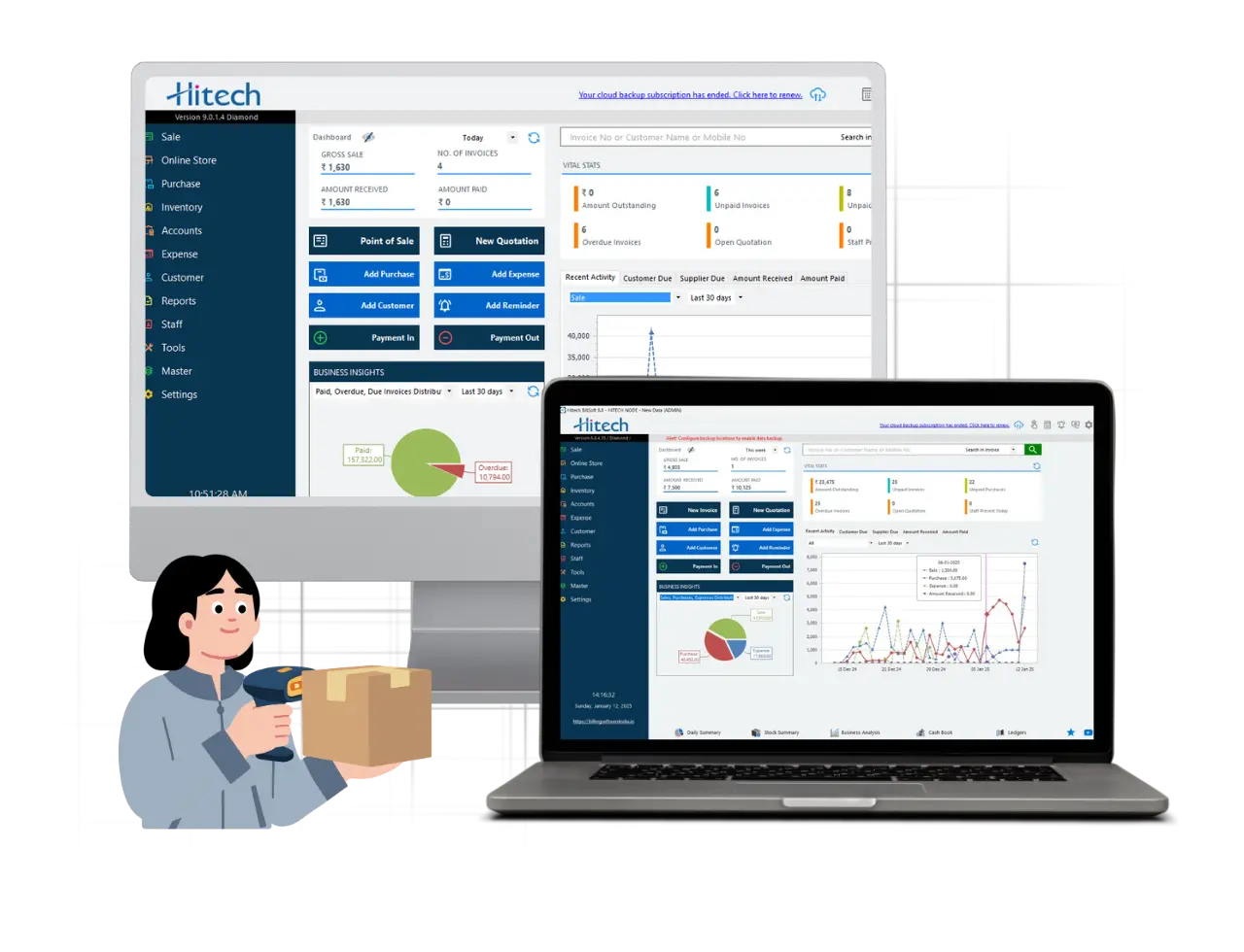
Join Millions of Business Owners already saving time and
money with Hitech Billsoft.
Want to calculate EMI, Interests and Loan Payments?