Try the Hitech Billsoft Software today and grow your business
Join Millions of Business Owners already saving time and
money with Hitech Billsoft.
Businesses crossing ₹10 crore in Annual Aggregate Turnover don't get unlimited time to push an invoice through the e-invoice system. Since 1 April 2025, any eligible invoice, credit note or debit note has to reach an Invoice Registration Portal for IRN generation within 30 days of the document's own date - miss that window, and the portal simply won't accept it anymore.
That rejection isn't just a technical inconvenience. It can leave you holding a document that doesn't count as a valid e-invoice, stall the buyer's Input Tax Credit, delay payment approvals, and throw off your GSTR-1 reconciliation.
This guide breaks down who the rule applies to, exactly how the 30-day count works, a practical filing checklist, and the habits that keep large-turnover businesses from getting caught out by the deadline.
The rule requires businesses above the threshold to submit eligible invoice data to an authorised Invoice Registration Portal within 30 days of the document's date. Once the portal validates that data, it issues an Invoice Reference Number, a digitally signed version of the invoice, and a signed QR code - together, these are what make the document a recognised e-invoice under GST.
It's worth being clear about what the rule doesn't say: it doesn't give a business 30 days to actually issue the invoice to the customer. The invoice still has to be created in line with the normal GST time-of-supply rules. The 30-day window only governs how long you have to get an already-created document through IRN generation.
The restriction applies where a taxpayer's Annual Aggregate Turnover is ₹10 crore or above, and that turnover is checked across every GSTIN registered under the same PAN, not GSTIN-by-GSTIN. Before assuming the rule applies - or doesn't - a business should confirm its combined turnover across all registrations, its e-invoicing enablement status, and whether its specific category or supply type carries any exemption.
It also helps to keep the ₹5 crore and ₹10 crore thresholds separate, since they cover different things:
| Requirement | Applies From |
|---|---|
| General mandatory e-invoicing | AATO above ₹5 crore, subject to notified exemptions |
| Strict 30-day IRP reporting cutoff | AATO of ₹10 crore or more |
| Below ₹10 crore but e-invoicing applies | E-invoice required; 30-day cutoff not currently imposed |
| Below ₹5 crore | E-invoicing generally optional unless another rule applies |
The 30-day restriction covers every document type that needs an IRN - B2B tax invoices, export invoices, debit notes, credit notes, and specified supplies to government or registered entities. Ordinary B2C invoices generally sit outside this rule, since B2C supplies don't go through IRN generation under the current framework. Some notified entities and supply types may also carry their own exemptions regardless of turnover, so it's worth checking category-specific rules before assuming full coverage.
The 30-day clock starts from the date printed on the invoice, credit note or debit note - not the date it's entered into your accounting system. An invoice dated 1 April, for example, has to reach the portal by 30 April; from 1 May onward, that same document gets rejected. The same logic applies whatever the starting date is - a 10 April invoice is good through 9 May, a 15 June invoice through 14 July, and so on.
Because the count runs on calendar days rather than working days, weekends and public holidays eat into the window just like any other day. That's exactly why waiting until close to day 30 is risky - a portal outage, a missing approval, or a staff absence at the wrong moment can push you past the deadline with no way back.
The 30-day window is a legal ceiling, not a working target. Businesses that generate IRNs the same day or the next avoid nearly every failure mode tied to this rule - portal downtime, missing approvals, or a data error caught too late.
Run through this checklist for every B2B invoice, export invoice, credit note or debit note that requires an IRN:
A daily reconciliation between your sales register and IRP records is what catches a missing IRN while there's still time to fix it - comparing invoice numbers, dates, GSTINs, taxable values and document status against what the portal actually shows on file.
A structured cadence of checks keeps the 30-day rule from ever becoming an emergency:
An ageing report with clear risk bands makes escalation almost automatic instead of a judgment call:
Once a covered document ages past the 30-day window, IRP validation blocks IRN generation for it outright. That has knock-on effects on both sides of the transaction:
Issuing a backdated or duplicate invoice after the reporting window has closed isn't a safe fix - the correct treatment depends on the transaction and your accounting records, and getting it wrong compounds the compliance risk. This is a case for a qualified GST professional, not a workaround.
A few recurring patterns explain most missed deadlines: batching all IRN generation into month-end GST closing instead of daily, sales teams creating invoices before buyer GSTIN details are confirmed, invoices stuck in multi-team approval chains, branch offices billing locally while head office handles IRP reporting with a lag, repeated validation errors from incorrect HSN codes or GSTINs, credit and debit notes getting overlooked because attention stays on sales invoices, and portal or integration downtime that isn't tracked and retried promptly.
An e-invoice can't be edited directly on the portal once the IRN has been issued. Where permitted, the IRN itself can usually be cancelled within 24 hours of generation; beyond that, corrections generally have to go through the appropriate GST return, a credit or debit note, or your standard accounting adjustment process. Keep a separate tracked process for cases like incorrect GSTINs, wrong taxable values, cancelled supplies, returned goods, or duplicated invoices - especially ones spotted after the 24-hour cancellation window has closed.
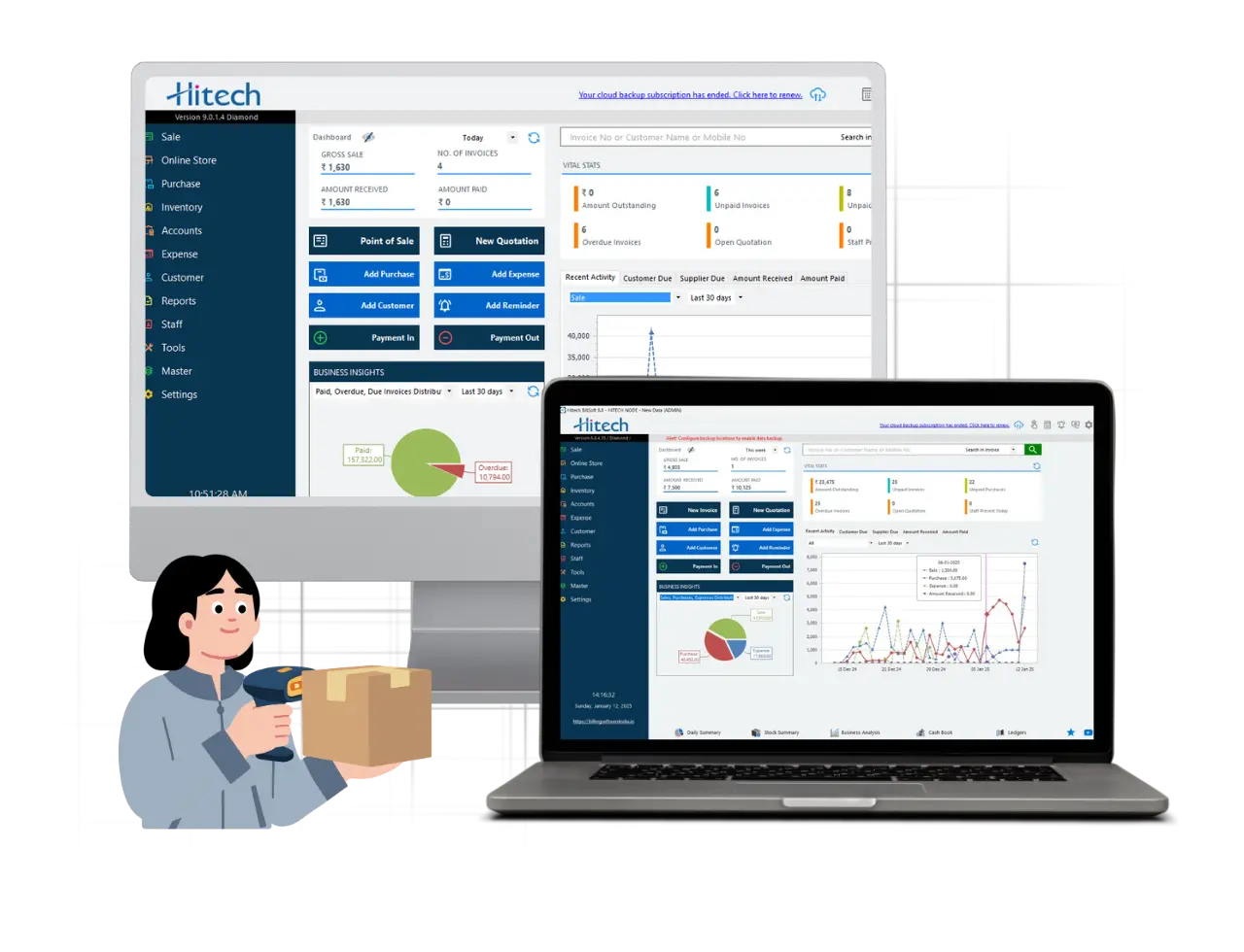
The businesses that stay ahead of this rule tend to have one thing in common: invoice creation and GST reporting living in the same system instead of scattered across spreadsheets and separate tools. Hitech Billsoft brings GST-compliant invoicing, automated tax calculations, customer and item master data, and business reporting into a single workflow, which shortens the gap between creating an invoice and getting it reported - exactly what the 30-day rule rewards.
Before wrapping up each period, confirm:
For ₹10 crore+ businesses, the 30-day e-invoice reporting rule isn't really about the deadline itself - it's about replacing a batch, month-end approach to compliance with a continuous one. The strongest safeguard isn't a reminder set for day 28; it's a same-day habit of validating the document, generating the IRN, and reconciling it against the books before it ever has a chance to age.
Clean master data, automated tax calculations, daily IRN generation, and clear escalation ownership do most of the work. Get those in place, and the 30-day window stops being a risk and becomes just another background process.

Join Millions of Business Owners already saving time and
money with Hitech Billsoft.