Try the Hitech Billsoft Software today and grow your business
Join Millions of Business Owners already saving time and
money with Hitech Billsoft.
Most billing mistakes on a GST invoice do not come from the wrong tax rate. They come from one small field that gets picked without much thought. That field is place of supply.
Place of supply decides whether your invoice should charge IGST, or CGST and SGST. Get it wrong, and the mistake does not stay small. It can affect your GSTR 1 reporting, your customer's Input Tax Credit, your e-way bill data, your branch transfer records, and your invoice reconciliation later.
The most common reason this goes wrong is simple. Many teams pick place of supply straight from the customer's billing address, every time, without checking how the goods were actually delivered. This guide will help you fix that habit and build a proper check into your billing process.
Before we get into the rules, it helps to know where things usually go wrong. Once you know these, the rules below will make a lot more sense.
Place of supply is the location that GST law uses to decide if a sale is interstate or intrastate. For goods, this comes mainly from Section 10 of the IGST Act.
It is not one fixed rule. It depends on how the sale actually happens, such as:
You need to work this out first. Only then can you decide whether to charge IGST or CGST and SGST.
This single field also touches far more than the tax amount. It affects your GST rate application, your GSTR 1 reporting, your customer's ITC claim, your e-invoice data, your e-way bill data, your state wise reports, your branch transfer accounting, and your audit trail. A wrong place of supply can show the wrong tax type even when your rate and value are both correct.
Once you know the place of supply, comparing it to the supplier location tells you the tax type.
| Supplier Location | Place of Supply | Tax You Should Charge |
|---|---|---|
| Same state | Same state | CGST + SGST |
| Same union territory | Same union territory | CGST + UTGST |
| Different states | Different state | IGST |
| State to union territory | Different area | IGST |
| Union territory to state | Different area | IGST |
Take a supplier in Maharashtra selling to a buyer in Maharashtra, with delivery also in Maharashtra. Here the place of supply is Maharashtra, the same as the supplier, so the invoice should carry CGST and SGST.
Now change just the delivery. If the same supplier sends the goods to a buyer in Gujarat instead, the place of supply becomes Gujarat. Since that is different from the supplier state of Maharashtra, the invoice should carry IGST.
This is the part to keep open while billing. Run through it before you finalise any GST invoice for goods.
Now that you have the checklist, here is how to apply the place of supply rule to five common situations. Each one comes with a real working example.
If the goods move from one place to another, no matter who moves them, the place of supply is wherever that movement ends. This is the most common situation. A supplier in Delhi sends goods to a customer in Rajasthan. The goods start in Delhi and are delivered in Rajasthan. So the place of supply is Rajasthan, and since this is different from the supplier's Delhi location, the invoice carries IGST.
This happens when the supplier bills one party but delivers the goods to a different person, on that buyer's instruction. The person who gave the instruction is treated as the one who received the goods. So the place of supply is that person's main place of business, not the final delivery address. A supplier in Maharashtra bills a buyer in Delhi. The goods are shipped directly to a party in Karnataka, because the Delhi buyer asked for it. Even though the goods land in Karnataka, the place of supply is Delhi, since that is where the delivery instruction came from. The invoice carries IGST.
If the goods stay exactly where they are and simply change ownership, the place of supply is the location of the goods at that time. A machine is already sitting inside a buyer's factory in Gujarat. Ownership of the machine changes hands, but the machine itself never moves. The place of supply is Gujarat, and the tax type depends on comparing the supplier's location to Gujarat.
If goods need to be installed or assembled somewhere, that installation site becomes the place of supply. A supplier sells and installs a large machine at a customer's plant in Tamil Nadu. The place of supply is Tamil Nadu, and the tax type depends on comparing the supplier's location to Tamil Nadu. This rule matters a lot for machinery, equipment, and plant installations.
If goods are supplied on board a vehicle, train, ship, or flight, the place of supply is wherever the goods were first loaded on board. Goods are sold on a train while it is at Mumbai. The place of supply is Maharashtra, since that is where the goods were taken on board.
These four fields often get mixed up, but they each mean something different.
| Field | What It Means |
|---|---|
| Bill From | The GSTIN or branch that issues the invoice |
| Dispatch From | The actual place the goods start their journey from |
| Bill To | The buyer who receives the invoice |
| Ship To | The place or person who receives the goods |
| Place of Supply | The location GST law uses to decide the tax type |
Here is a case where all four are different. A company bills from its Mumbai GSTIN, but the goods are actually sent from a warehouse in Pune. The invoice is billed to a customer in Delhi, but the goods are shipped to a party in Jaipur, because the Delhi customer asked for it. In this case, the Bill From is Mumbai, the Dispatch From is Pune, the Bill To is Delhi, the Ship To is Jaipur, and the place of supply is Delhi, since this is a Bill to Ship to case.
Every one of these fields has to be entered correctly and separately across your invoice, your e-invoice, and your e-way bill.
A company transfers goods from its Maharashtra GSTIN to its own Karnataka GSTIN. Even though this feels like an internal move, the two GSTINs can be treated as separate persons under GST. Here, the place of supply is Karnataka, and the invoice carries IGST. This kind of transfer needs to be documented properly and matched against your e-way bills and inventory records, using a tax invoice where the transfer is taxable.
Do not wait until something looks wrong. Build this check into your process every period, before filing.
A simple internal report can help here. It only needs a handful of columns.
| Invoice No | Supplier State | Buyer State | Ship To State | Place of Supply | Tax Charged | Expected Tax | Status |
|---|---|---|---|---|---|---|---|
| INV 001 | Maharashtra | Gujarat | Gujarat | Gujarat | IGST | IGST | Correct |
| INV 002 | Maharashtra | Delhi | Karnataka | Karnataka | IGST | Review needed | Check |
| INV 003 | Karnataka | Karnataka | Karnataka | Karnataka | IGST | CGST + SGST | Error |
| INV 004 | Rajasthan | Madhya Pradesh | Madhya Pradesh | Madhya Pradesh | IGST | IGST | Correct |
Run this check every period, well before they turn into a bigger reconciliation issue at filing time. Give priority to high value invoices and to customers who use more than one ship to address. Fix whatever needs fixing in the invoice, debit note, or credit note before you file, working with your GST advisor where needed.
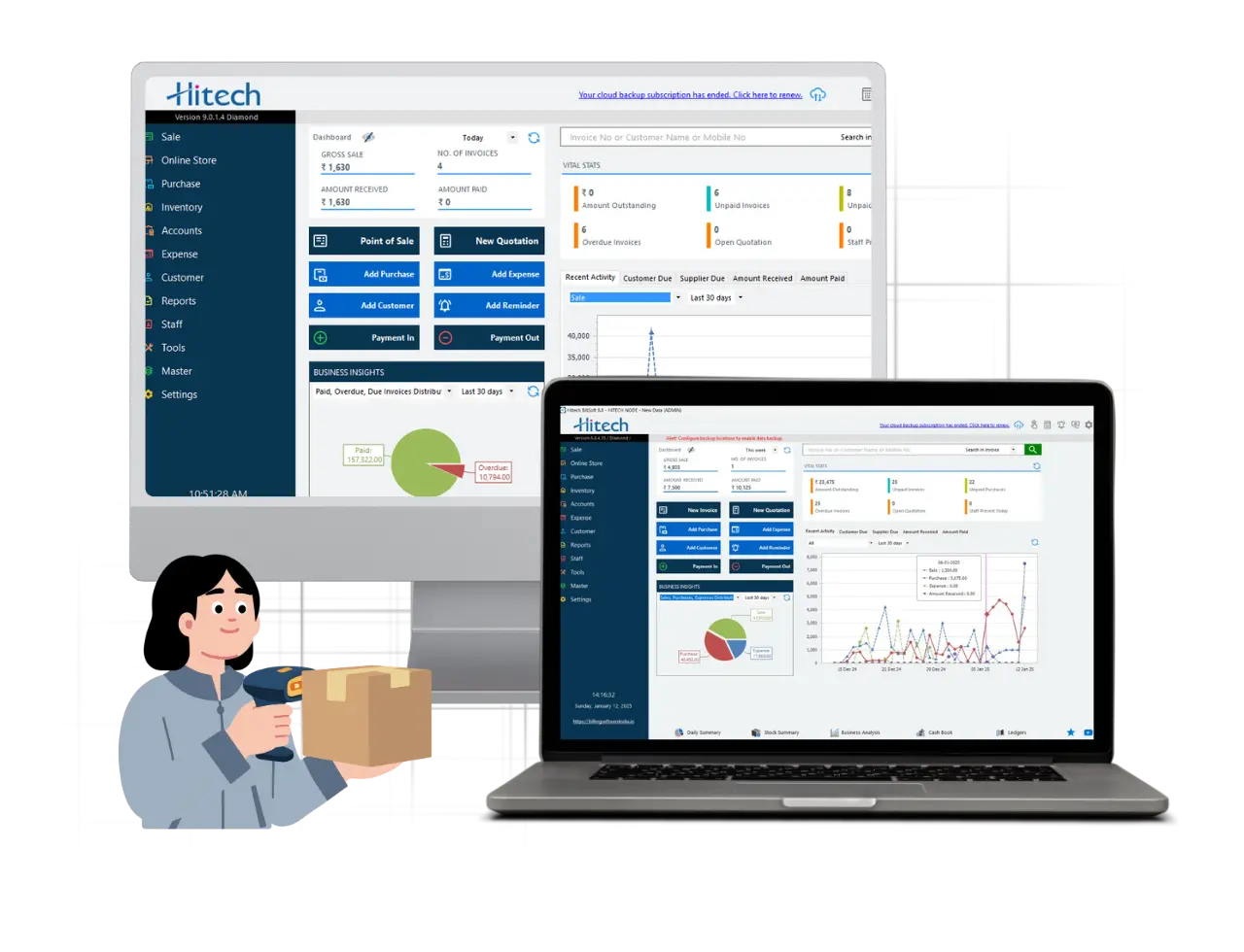
Keeping track of Bill From, Dispatch From, Bill To, Ship To, and place of supply across every invoice is easy to get wrong when it is done manually. Hitech Billsoft applies the correct place of supply rules automatically based on the transaction details you enter, flags mismatches before the invoice is saved, keeps your GSTIN and state records accurate across customers and branches, and generates e-invoice and e-way bill data that is consistent with each invoice. For businesses dealing with regular interstate sales, Bill to Ship to orders, or branch transfers, this removes most of the manual checking that currently falls on your billing team.
Place of supply is not a field to fill by habit. It is the foundation of whether your invoice is GST compliant. Get it right, and your tax type, your return filing, your customer's ITC, and your transport documentation all align. Get it wrong, and the error spreads across every system that touches that invoice.
The checklist in this guide is designed to be used at the billing stage, not after the fact. Run through it consistently, build the audit into your pre-filing process, and most of the common place of supply mistakes simply stop occurring.
Join Millions of Business Owners already saving time and
money with Hitech Billsoft.