Try the Hitech Billsoft Software today and grow your business
Join Millions of Business Owners already saving time and
money with Hitech Billsoft.

It is the last day of the month. Your sales register looks healthy. Your customers are happy. And yet, when you open the cash drawer to pay your supplier, the money is not there.
Almost every small business owner in India has lived this moment at least once. The problem is rarely sales. The problem is that nobody wrote down where the cash went the small auto fare, the cash taken out for a personal errand and never returned, the amount handed to a supplier without a voucher.
A cash book for MSMEs solves exactly this. It is the oldest, simplest and most under-used financial record in Indian small business and once it is maintained properly, your cash stops disappearing. This guide covers what a cash book is, every format you can use, the tax rules that apply to it, and a practical daily system you can start using tomorrow morning.
A cash book is a financial record in which a business enters every cash receipt and every cash payment on the day it happens, along with the running cash balance. It works as both a book of original entry and a ledger account, which means no separate cash ledger is needed.
A cash book records money coming in on one side and money going out on the other. At the end of each day, the difference between the two sides is your cash in hand - the exact amount that should physically be in your drawer.
What makes it different from every other book of accounts is its dual role:
What a cash book records:
What a cash book does not record:
These four terms get used interchangeably by MSME owners, and the confusion causes real filing errors. Here is the clean distinction.
| Record | What it is | Who maintains it | Where it lives |
|---|---|---|---|
| Cash book | Daily record of all cash receipts and payments; acts as journal and ledger | Your business | Your books / billing software |
| Cash account | Only a ledger account, prepared from journal entries | Your business | Your ledger |
| Petty cash book | A subsidiary book for small routine expenses, usually run on the imprest system | Your cashier or store staff | Your books |
| GST Electronic Cash Ledger (Form GST PMT-05) | Balance of tax money deposited with the government, used to pay GST liability | Auto-maintained by the GST portal | GST portal, not your books |
Your Electronic Cash Ledger on the GST portal has nothing to do with the cash in your drawer. It only reflects tax deposited via challan. Your cash book is your own record, and the two are never a substitute for each other.
There are four working formats. Pick the one that matches how your business actually receives and pays money.
1. Single Column Cash Book
Records only cash transactions. One amount column on each side. Best for small kirana stores, tea stalls, service providers and street-front retailers whose business runs almost entirely on cash and who use the bank rarely.
2. Double Column Cash Book (Cash + Bank)
Adds a bank column beside the cash column on both sides, so cash and bank movement is tracked in one book. Best for any MSME that accepts UPI, cheques or bank transfers alongside cash - which today is most retailers, salons, clinics and small traders.
3. Triple Column Cash Book (Cash + Bank + Discount)
Adds a discount column. Discount allowed appears on the receipts side, discount received on the payments side. Best for distributors, wholesalers and traders who regularly give or take early-payment discounts. The discount columns are totalled, not balanced - they are memorandum columns carried to the discount ledger accounts.
4. Petty Cash Book (Imprest System)
A separate small book for routine low-value expenses - conveyance, tea, stationery, courier, loading charges. Under the imprest system, the cashier is given a fixed float. At the end of the period, whatever has been spent is reimbursed, restoring the float to its original amount. This keeps hundreds of tiny entries out of the main cash book while still recording every rupee. Best for any business with more than two or three staff handling day-to-day spending.
Here is a full working day for a fictional retailer, Sharma General Store, in a triple column cash book.
Opening balances on 12 August: Cash ₹8,500 | Bank ₹1,45,000
The day's transactions:
Receipts Side (Dr)
| Date | Particulars | L.F. | Discount Allowed (₹) | Cash (₹) | Bank (₹) |
|---|---|---|---|---|---|
| 12 Aug | To Balance b/d | — | — | 8,500 | 1,45,000 |
| 12 Aug | To Sales | — | — | 22,400 | — |
| 12 Aug | To Verma Traders | — | 200 | — | 15,000 |
| 12 Aug | To Cash (C) | — | — | — | 15,000 |
| Total | 200 | 30,900 | 1,75,000 | ||
Payments Side (Cr)
| Date | Particulars | L.F. | Discount Received (₹) | Cash (₹) | Bank (₹) |
|---|---|---|---|---|---|
| 12 Aug | By Gupta Distributors | — | 150 | 9,000 | — |
| 12 Aug | By Staff Refreshments | — | — | 350 | — |
| 12 Aug | By Delivery Charges | — | — | 450 | — |
| 12 Aug | By Bank (C) | — | — | 15,000 | — |
| 12 Aug | By Electricity (UPI) | — | — | — | 3,200 |
| 12 Aug | By Balance c/d | — | — | 6,100 | 1,71,800 |
| Total | 150 | 30,900 | 1,75,000 | ||
Closing cash in hand: ₹6,100. Closing bank balance: ₹1,71,800.
Step 1: Set your opening balance - Count the physical cash in your drawer today and note your bank balance. That is your opening balance. Every future day begins with yesterday's closing balance carried forward.
Step 2: Record every transaction the same day - Not weekly. Not "when I get time." An unrecorded expense today is a gap you will never find at month end.
Step 3: Mark contra entries clearly - Any cash deposit into the bank or withdrawal from it gets written on both sides with a "C". This single habit prevents your cash and bank balances from double-counting.
Step 4: Attach a voucher number to every entry - Every payment should reference a bill, receipt or internal voucher number. Without a trail, an entry is just a claim.
Step 5: Total and close the book daily - At day end, total both sides, calculate the closing balance and carry it forward.
Step 6: Physically count the cash and match it to the book - Count your notes and coins by denomination. If the physical cash does not equal the book balance, find the difference today, while people still remember. A denomination count sheet taped inside the drawer takes thirty seconds and catches most errors.
Step 7: Reconcile the bank column monthly - Compare your bank column against your bank statement. Cheques issued but not yet cleared, and bank charges you were unaware of, are the usual causes of difference.
For a large number of MSMEs, yes and the answer is more binding than most owners assume.
Under the Income Tax Act (Section 44AA + Rule 6F)
Rule 6F names the cash book as the first prescribed book of account. The obligation to maintain books applies as follows:
| Category | Threshold |
|---|---|
| Specified professions (legal, medical, engineering, architectural, technical consultancy, interior decoration, film artist, authorised representative, accountancy, company secretary, information technology) | Gross receipts exceed ₹1,50,000 in any of the 3 preceding years |
| Business or non-specified profession Individual / HUF | Income exceeds ₹2,50,000 or turnover / gross receipts exceed ₹25,00,000 in any of the 3 preceding years |
| All other entities (firms, LLPs, companies, AOP/BOI) | Income exceeds ₹1,20,000 or turnover / gross receipts exceed ₹10,00,000 in any of the 3 preceding years |
| Newly set up business | The current year's expected income or turnover is tested against the same limits |
Up to ₹25,000 under Section 271A.
Under GST (Section 35 and Rule 56)
Every registered person must keep true and correct accounts of production or manufacture, inward and outward supplies, stock, input tax credit availed, and output tax payable and paid - at the principal place of business and at every additional place of business.
Two clauses matter enormously for cash books:
How long must you keep it?
Under Section 36 of the CGST Act, records must be retained for 72 months (6 years) from the due date of furnishing the annual return for that year. Where an appeal, revision, proceeding or investigation is involved, records must be kept for one year after final disposal, or the above period, whichever is later.
Your cash book is where these rules either protect you or expose you.
| Provision | The limit | What happens if you cross it |
|---|---|---|
| Section 40A(3) | Cash payment (or aggregate of payments) to one person in one day above ₹10,000 - ₹35,000 for goods carriage operators | The entire expenditure is disallowed as a deduction. Not a fine - you lose the deduction completely |
| Section 40A(3A) | A liability already claimed as a deduction, later settled in cash above ₹10,000 | The amount becomes deemed income in the year of payment |
| Section 269ST | Receiving ₹2,00,000 or more in cash from one person in a day, for a single transaction, or for one event or occasion | Penalty under Section 271DA equal to 100% of the amount received |
| Sections 269SS / 269T | Accepting or repaying a loan, deposit or specified advance of ₹20,000 or more in cash | 100% penalty |
Section 40A(3) binds the payer, not the receiver. So a shopkeeper is legally free to accept up to ₹1,99,999 in cash from one customer in a day under Section 269ST - but that customer, if buying for business purposes, will lose the deduction on anything above ₹10,000 paid in cash. Payments through account-payee cheque, account-payee draft, ECS or prescribed electronic modes such as UPI, NEFT, RTGS and IMPS fall outside the 40A(3) restriction entirely. Rule 6DD lists further exceptions.
Practical takeaway: keep a "mode of payment" column in your cash book. It turns a compliance risk into a two-second check.
| Mistake | Why it hurts | The fix |
|---|---|---|
| Mixing personal and business cash | Profit figures become fiction; auditors reject the books | Keep a separate drawer and record owner withdrawals as drawings |
| Writing entries once a week | Small expenses are forgotten permanently | Enter at the time of the transaction, not at day end |
| No voucher or bill reference | Nothing is verifiable during assessment | Number every voucher and reference it in the entry |
| Ignoring contra entries | Cash and bank balances get double counted | Mark every deposit and withdrawal with "C" on both sides |
| Overwriting a wrong entry | Directly violates Rule 56(8) | Strike through under attestation, then enter the correction |
| Never physically counting cash | Leakage goes undetected for months | Count by denomination and match to the book every evening |
| Treating UPI receipts as "cash" | Bank balance never reconciles | UPI is a bank column entry, not a cash column entry |
| No monthly bank reconciliation | Bank charges and uncleared cheques distort the balance | Reconcile the bank column against the statement every month |
| Factor | Manual register | Digital cash book |
|---|---|---|
| Entry speed | Slow, handwritten | Recorded automatically as bills are made |
| Arithmetic errors | Common, especially in totalling | Balances calculated automatically |
| Audit trail | Depends on handwriting and attestation | Timestamped entries with user identity |
| Edit log (Rule 56(8)) | Not possible | Maintained by the software |
| Searching an old entry | Page-by-page hunting | Search by date, party or amount in seconds |
| Reports | Prepared manually at month end | Generated instantly |
| Risk of loss | Fire, water, theft, misplacement | Encrypted automatic backups |
| GST readiness | Needs re-entry into filing software | Data already structured for GSTR filing |
The verdict: a manual register is acceptable in law and workable at very low volume. The moment you cross roughly twenty transactions a day, or you are handling both cash and UPI, manual maintenance costs more in errors and time than the software costs in money.
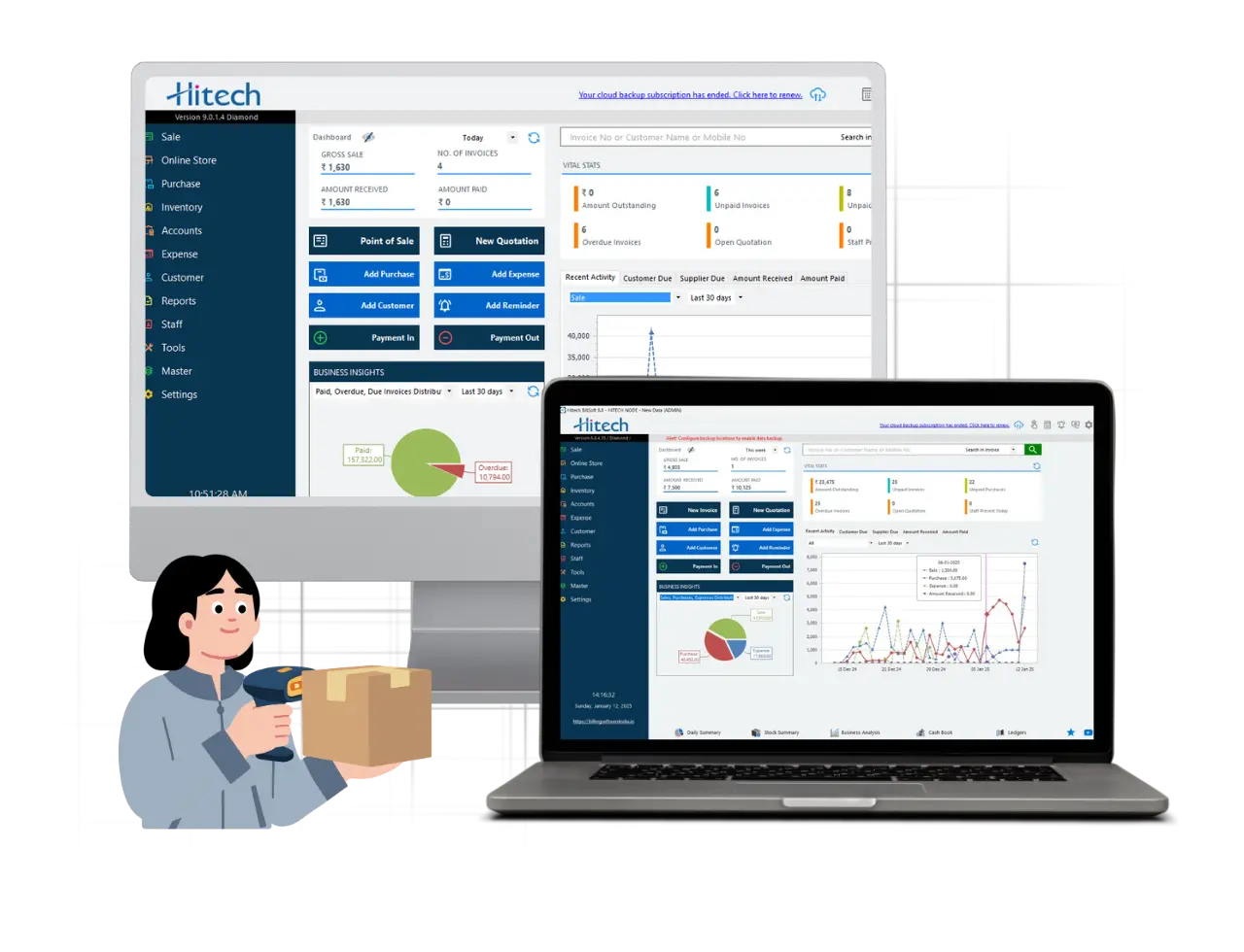
Consider a normal day at a store running Hitech Billsoft.
Because entries are timestamped and edits are tracked in software rather than scratched out on paper, the record stands up to the "no erasing, no overwriting, maintain an edit log" requirement of Rule 56(8) in a way a paper register or an open Excel file cannot.
You do not need to wait for a new financial year. Five steps:
Daily
Weekly
Monthly
A cash book is not paperwork you keep for your CA. It is the one record that tells you, every single evening, whether your business actually has the money it thinks it has. Maintained properly, it prevents shortages, exposes leakage, satisfies both income tax and GST requirements, and makes you credible in front of a lender.
The format matters less than the habit. Start with the right columns, record on the same day, count your cash before you close, and reconcile with your bank each month. And if the daily totalling is what keeps stopping you, let software do it - Hitech Billsoft records your cash and bank position as you bill, works offline, and keeps your records backed up and audit-ready.

Join Millions of Business Owners already saving time and
money with Hitech Billsoft.