Try the Hitech Billsoft Software today and grow your business
Join Millions of Business Owners already saving time and
money with Hitech Billsoft.
A PO number is a unique reference number the buyer assigns to a purchase order before placing an order. The supplier quotes that same number on the invoice so the buyer's accounts team can match the bill against the order they already approved which is what gets the invoice verified and paid.
That one field decides whether your invoice moves or sits.
| Question | Short answer |
|---|---|
| Who creates the PO number? | The buyer, before the order is placed |
| Is it mandatory on a GST invoice? | No - it is not one of the particulars listed under Rule 46 |
| Where does it go on the invoice? | In the header block, near the invoice number and date |
| Can one PO have several invoices? | Yes - partial deliveries and staged billing are normal |
| What if it is missing? | The buyer's team can hold, query or reject the invoice |
A purchase order (PO) is the buyer's formal, written commitment to buy specific goods or services at an agreed quantity and price. The PO number is the unique reference stamped on that document.
When you supply against that order and raise your invoice, you quote the buyer's PO number back to them. Two documents, one thread connecting them.
Three things a PO number is not:
A worked example
A distributor in Ghaziabad receives an order from a manufacturing company:
Step 4 is the whole point. Without that reference, someone has to work out which order this invoice belongs to - and that guesswork is where payment delays begin.
In Indian trade, the PO sits in the middle of a document chain, not at the start of it. Your quotation proposes. The buyer's PO accepts and authorises. Your challan moves the goods. Your invoice claims the money and carries the PO reference so the buyer can tie the claim back to the authorisation.
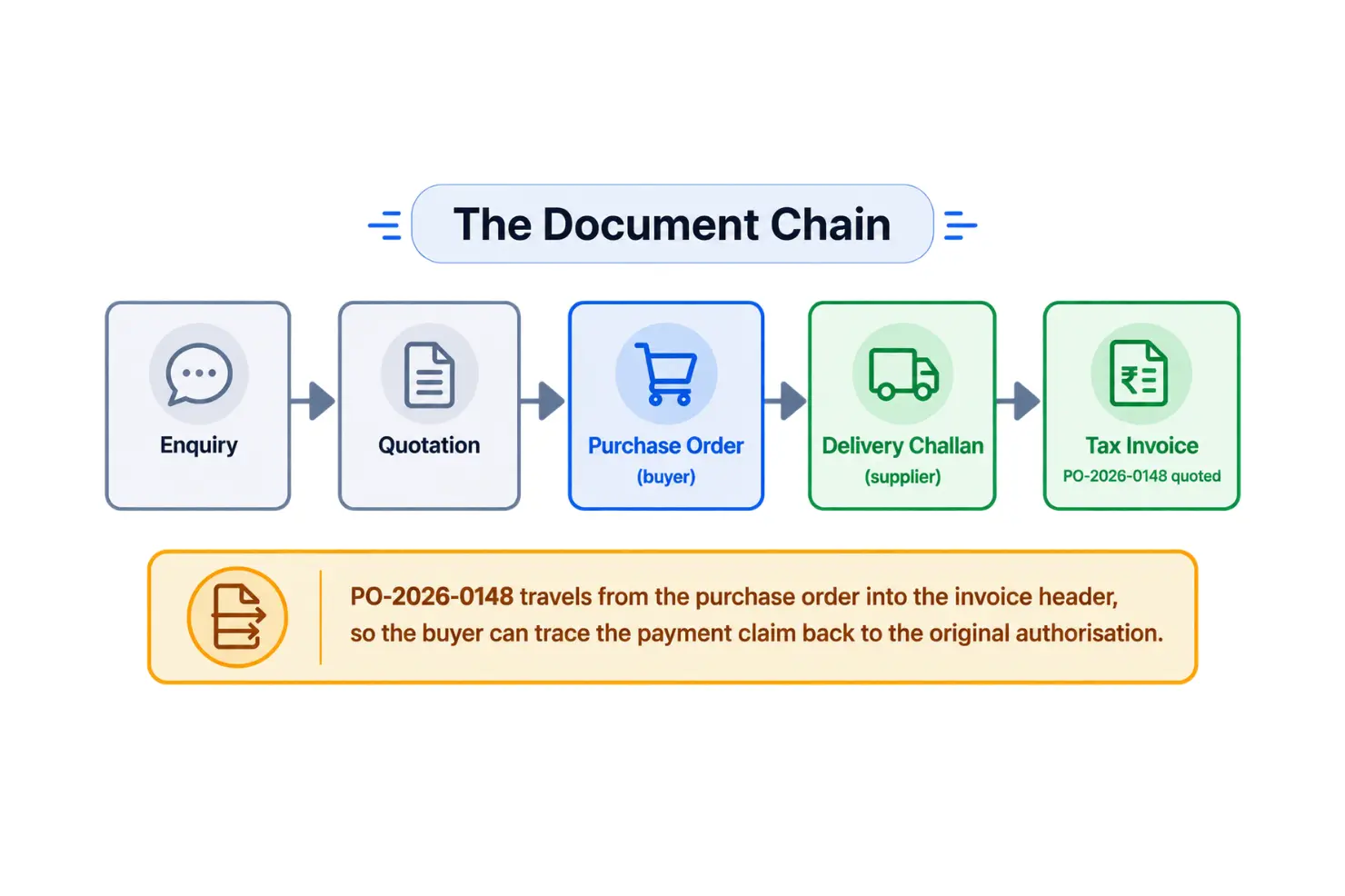
For businesses moving goods, the e-way bill runs alongside this chain. The PO number itself has no role in e-way bill generation, but a consistent reference across challan and invoice makes reconciliation far easier when a consignment is questioned.
Four numbers commonly appear on the same invoice and get confused with each other:
| PO Number | Invoice Number | Challan Number | IRN | |
|---|---|---|---|---|
| Created by | Buyer | Seller | Seller | Invoice Registration Portal |
| Created when | Before the purchase | At billing | At dispatch | After the invoice is reported |
| Purpose | Authorises the purchase | Requests payment | Records movement of goods | Validates the e-invoice |
| Required by GST law | No | Yes | For non-sale movement | Only above the e-invoicing threshold |
| Relationship | One PO → one or many invoices | One invoice → one number | One invoice → one or many challans | One invoice → one IRN |
The buyer numbers the order, the seller numbers the bill.
Suppliers often read a PO requirement as bureaucracy. It isn't. Inside any organisation with a procurement function, your invoice runs through a verification routine called a three way match before anyone approves payment. Three documents are compared, line by line:
| Document | Who creates it | What it proves |
|---|---|---|
| Purchase order | Buyer's procurement team | What was ordered, at what rate |
| Goods receipt note (GRN) | Buyer's stores or warehouse | What was actually delivered |
| Supplier invoice | You | What is being charged |
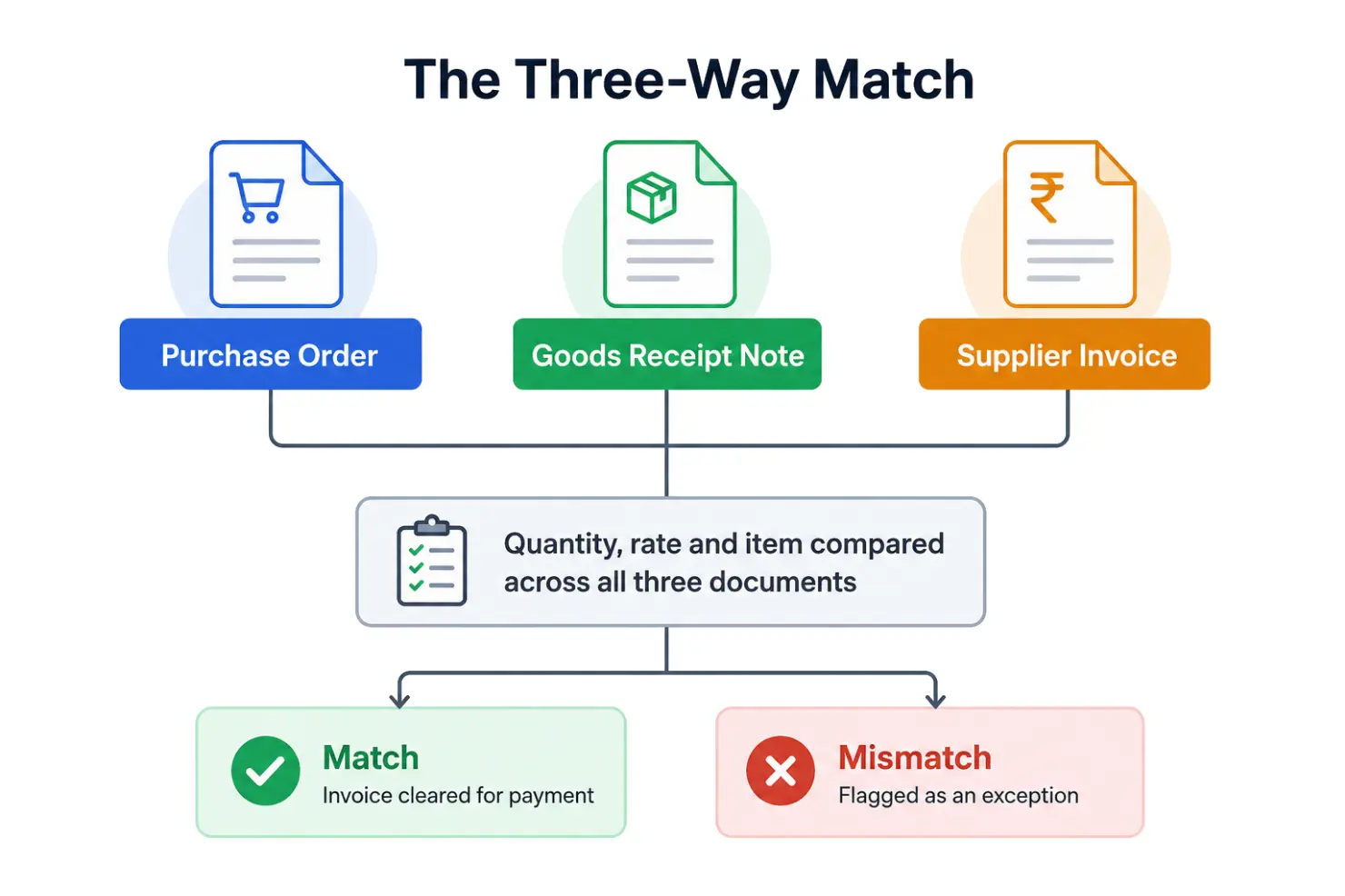
If all three agree on quantity, rate and item, the invoice is cleared. If any of them disagree, the invoice is flagged as an exception and parked until someone investigates.
Smaller variations exist. A two way match compares only the PO and the invoice common for services, where there is no physical delivery to record. A four way match adds a quality inspection or acceptance report, typical in manufacturing and pharma.
Now look at what happens when your invoice arrives without a PO number. The AP clerk has the invoice and the GRN but no reliable way to find the third document. The match cannot be completed. Your invoice isn't being difficult it is failing a check. This is also why buyers ask you to use their PO number rather than your own reference. Their system indexes purchases by that number. Anything else is unsearchable.
No a PO number is not required for a tax invoice to be valid under GST.
Rule 46 of the CGST Rules, 2017 lists the particulars a tax invoice must contain. In practice, that means:
A PO number appears nowhere on that list. Omitting it will not make your invoice noncompliant, and it will not affect your customer's input tax credit.
But the e-invoice standard does make room for it
If your turnover puts you above the e-invoicing threshold, the picture is slightly more interesting. The e-invoice schema separates fields into mandatory and optional, and the optional set includes references to contracts, vendor purchase orders, e-way bill numbers, contact details and place of dispatch - precisely so the standard can accommodate how businesses actually trade.
So the honest position is this: a PO number is not required by law, but it is formally recognised by the invoicing standard. Not compliance. Commerce.
This is the part most suppliers never connect, and it matters more than the field itself.
Under Section 15 of the MSMED Act, a buyer purchasing from a registered micro or small enterprise must pay within a defined window. Where there is a written agreement, the credit period cannot exceed 45 days from the day of acceptance or deemed acceptance. Where there is no written agreement, the buyer must pay by the appointed day which falls shortly after a 15-day window from acceptance.
Two consequences follow, and both run through the purchase order.
First, the PO is often the written agreement. If the buyer's PO states payment within 30 days, that shorter term governs the buyer does not get to fall back on 45 days. Equally, a PO stating 60 or 90 days cannot stretch the statutory ceiling. The document you filed away is the document that fixes your terms.
Second, the clock runs from acceptance, not from your invoice date. If the buyer raises no written objection within 15 days of delivery, the goods are treated as accepted on the delivery date, and the count begins whether or not anyone signed anything.
Where payment is delayed beyond that window, the Act provides for compound interest with monthly rests at three times the RBI bank rate, and disputes can be referred to the Micro and Small Enterprises Facilitation Council.
None of that is enforceable on memory. It is enforceable on documents the PO carrying the agreed terms, the challan carrying the delivery date, and the invoice carrying the PO reference that binds them together.
This is general information, not tax or legal advice. Confirm your position with your CA or advisor, and check your Udyam registration status before relying on these provisions.
Put it in the header block, alongside the details a verifier reads first:
| Invoice No. | INV/2026-27/0312 | PO No. | PO-2026-0148 |
| Invoice Date | 14 August 2026 | PO Date | 02 August 2026 |
| Customer | Sharma Packaging Pvt Ltd | ||
| GSTIN | 09XXXXXXXXXXXZX | ||
| Place of Supply | Uttar Pradesh (09) | ||
Three practical notes:
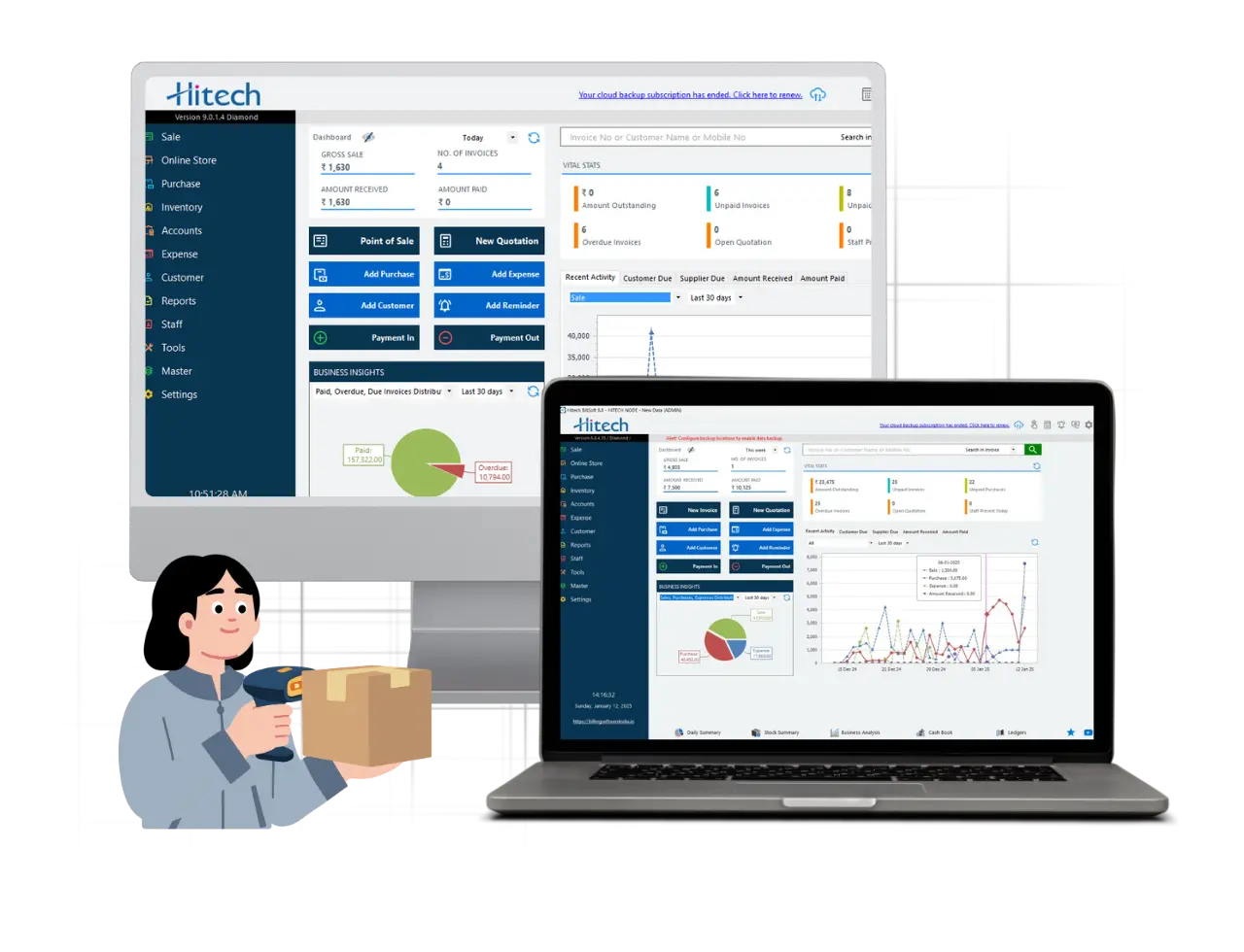
Because Hitech Billsoft runs offline on your desktop, the reference is stored with the invoice on your own machine - so when a buyer calls three months later asking which invoice covered PO-2026-0148, the answer is in your own records, not in someone's inbox.
The reverse side of this is worth setting up too. If you buy stock regularly, issuing purchase orders to your suppliers gives you the same control your corporate customers exercise over you:
Hitech Billsoft's purchase side handles purchase bills, purchase returns, supplier ledgers and payments, so the ordering discipline you apply outward can be reconciled inward against the same records.
There is no prescribed format. Buyers set their own. Common patterns:
| Pattern | Example | Typical user |
|---|---|---|
| Prefix + year + sequence | PO-2026-0148 | Most corporates |
| Prefix + sequence only | PUR-45892 | High-volume procurement |
| Department code + series | ABC/PO/1025 | Multi-division companies |
| Financial year based | PO/25-26/0087 | Indian businesses aligning to FY |
If you are designing your own series, four rules cover most problems:
| Situation | What to do |
|---|---|
| Goods delivered in parts | Raise separate invoices, each quoting the same PO number. One PO to many invoices is normal and expected. |
| Your invoice value exceeds the PO value | Stop before invoicing. Ask for a revised or supplementary PO - the match will fail on value otherwise. |
| The buyer amends the PO after you invoiced | Ask which reference their system now holds, and issue a corrected document only if they require it. |
| The PO has expired or been cancelled | Do not invoice against it. Request a fresh PO in writing. |
| A blanket or open PO across several months | Quote the same PO number each time, and add a release or call-off number if the buyer uses one. |
| Advance payment before any PO exists | Issue a proforma invoice. It is not a tax invoice and carries no PO reference until the order is confirmed. |
| Services, where no GRN exists | Expect a two-way match instead. Quote the PO and attach a timesheet, milestone sign-off or completion note. |
| Government or PSU supply | Assume the PO or supply order number is compulsory and quote it exactly, including every slash and prefix. |
It happens. What the buyer needs depends on how strict their system is.
Ask the buyer which they need before doing anything. The fastest route is almost always a written reply, not a new document.
| Mistake | Consequence |
|---|---|
| Inventing your own PO number | The reference doesn't exist in their system; the invoice cannot be matched |
| Entering your invoice number in the PO field | Guaranteed exception; someone has to call you |
| A single typo in the number | The search returns nothing, and the invoice sits |
| Leaving it blank when the buyer requires it | Held or rejected at intake |
| Quoting a cancelled or expired PO | Rejection, plus a difficult conversation about unauthorised supply |
| Using one PO across an unrelated order | Value mismatch, and a query on both orders |
| Dropping the PO from partial invoices after the first | Later invoices go unmatched |
| Never asking whether a PO exists | You find out at the payment-follow-up stage, weeks late |
Before you share any B2B invoice:
Asking for a PO before you invoice
Hello [Name], thank you for the order. Before we raise the invoice - do you issue a purchase order for this? If yes, please share the PO number and a copy of the order so we can quote it correctly and avoid any delay at your end. Regards, [Your name], [Business name]
Following up on a stalled invoice
Hello [Name], following up on invoice [INV number] dated [date] for [amount], raised against your PO [PO number]. Could you confirm whether it has been received and processed, and let us know if anything further is needed from our side? Regards, [Your name], [Business name]
Naming the PO in a follow-up changes the question from "which invoice?" to "where is this one stuck?" - a much easier question for the person reading it to answer.
Adding a PO reference is a small habit that works best when the software does not fight you:
A PO number is a small field with a large influence on how quickly you get paid. It carries no GST obligation, but it is the reference your customer's accounts team needs to complete their verification and release payment.
Ask whether a purchase order exists before you invoice, copy the number exactly, and keep it visible in the header. That is the whole discipline - and for suppliers dealing with corporates, government departments and manufacturers, it is often the difference between an invoice that clears and one that waits.
Join Millions of Business Owners already saving time and
money with Hitech Billsoft.